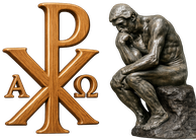
Nietzsche's Nihilistic Diatribe
In the parable of the madman (Nietzsche 2011), Nietzsche, through his herald, announces that God is dead . Since the normative supremo has bled under his knife and His institutions rendered obsolete, orthodox morality has been eroded at its foundation. He paints a picture of a Godless world, where churches now turn into mere sepulchers of the dead God. Ever the consistent iconoclast, he is ready to brave this grim aftermath of a Godless world, now adrift in an infinite void, and running its course of nihilism. In Beyond Good and Evil, he attempts to fill this vacuum with his own radical proposal: the Will to Power, deemed to transcend both the good and the evil.
Surveying a brutal history of bloodthirsty cruelty and violent conquests, he believes that in the end, it is the fittest who have survived, and we must learn from their ascendancy. Akin to the apathetic natural world of Richard Dawkins, there is at bottom no good, no evil, but sheer pitiless indifference in the marathon of evolution. He wants to incarnate this historical “Will to denial of life” as “Will to Power”. From an “is” of history, he draws an “ought” for the future. He is also implicitly committed to the rigid and fatalistic hierarchy of class. The aristocrats must ride on the slave plebeians to ascend to the sun like a heliotropic mistletoe exploits its host tree. Furthermore, through empirical observation, he has learnt that every prevailing moral scheme is a necessary dichotomy between slave-morality and the master-morality. He is quick to remind us that this bifurcation runs not just through civilization, but also deep in one’s own soul. Perhaps, he draws from the Socratic dialogue with Glaucon in the Republic, where Socrates likens a man to a city (Cornford 1945, 55). And the rational faculty must curb the spirited and the appetitive faculties, or else it, inevitably, will yield to their dominance. Enslavement is baked into the fabric of Nietzsche’s cosmos. Nature reports only between the binary of the ruled and the ruler, or between being the noble or being the despicable.
Critique
Nietzsche commits several fallacies while building his edifice of how one must live. First, he makes an “is-ought” fallacy. History is chequered with violence and oppressive civilization. What grounds do we have to say that our morality must be based on such hegemonic attitudes? In fact, a careful reading of history shows that civilizations have imploded under moral decadence. Sociologist Pitrim Sorokin has shown that ideational cultures whose worldview gives precedence to transcendent spiritual entities like God and selfless morality have flourished well over sensate cultures whose worldview disregards such categories (Sorokin 1985). Consider, for example, the once majestic Roman empire whose leaders were embroiled in hedonism, “Carpe diem” sensualism, and elitism, while the slaves relied on bread and circus eventually contributing to the economic decline and political turmoil (Sorokin 1985, 278–280).
It is difficult to extract valid arguments from his dense and elaborate polemic and predisposed disdain towards the non-aristocrats. A pervasive fallacy in Nietzsche’s tirade is the wholesale straw-manning of all non-elites. He has cherry-picked or fabricated the most distorted examples of hypocrisies and concluded them stemming from slave morality, i.e. entirely based on resentment. Replete with ad hominem, he endlessly poisons the well of any alternative ethics to his. He villainizes laymen and glorifies the elites while blatantly celebrating the attitude of a “beast of prey”. His role models are less like Hector of Troy and more like the ravenous Eric Bloodaxe.
Beyond Good and Evil is, therefore, a fallacious antithesis to the Sermon on the Mount. Its transvaluation of values leads to nihilism, and its arbitrary predilection for beastly survival as the highest end is a far cry from appealing. His writings read more like a malicious diatribe than a reasonable critique or argumentation.